
Sintered Wire Mesh
Multi-Layer Sintered Wire Mesh: High-Performance Filtration Laminates
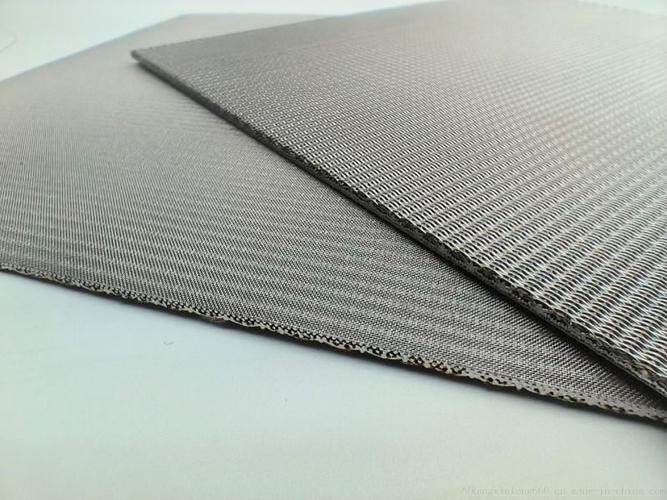
Our Sintered Wire Mesh is an advanced porous material created by bonding multiple layers of woven wire cloth through a specialized vacuum sintering (diffusion bonding) process. This results in a unified, rigid sheet that combines the precise filtration of fine mesh with the structural reinforcement of coarse mesh. Unlike traditional single-layer woven mesh, our sintered laminates will not fray, shift, or deform under high pressure.
Materials:
· Standard Material: 316L Stainless Steel (90% of applications).
· Specialty Alloys: 304, 321, 904L, Monel, Hastelloy, and Inconel.
· Temperature Range: Sustained operation from -200°C to 650°C
Micron size: 0.5um 1um ....100um
Thickness: 1.0mm 1.7mm(5Layers standard sintered wire mesh) 3.5mm(6 layers sintered wire mesh) or custom
Layer: 2 3 4 5 6 10 layers
Sheet size: 1000mm*500mm 1200mm*600mm 1000mm*1000mm, 1200mm*1500mm
Sintered wire mesh types:
· Sintered Mesh with Perforated Metal: Adding a layer of perforated stainless steel plate for applications involving extreme mechanical shock or extreme pressure.
· Pleated Sintered Mesh: By pleating the sintered sheet, we can increase the effective filtration area by 3x to 5x, extending the time between cleaning cycles.
· Dutch Weave Sintering: Utilizing "Dutch Weave" layers for ultra-fine surface filtration and superior air distribution (fluidized beds).
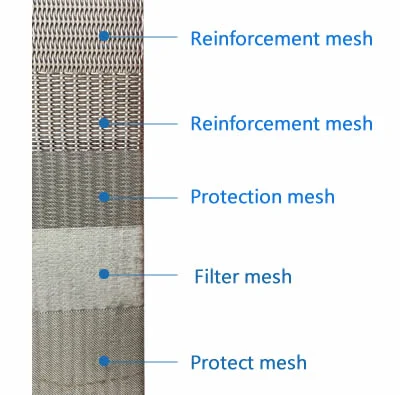
Technical Specifications & Layer Structure:
The most common configuration is the 5-Layer Standard Sintered Mesh, engineered for maximum stability:
1.Protective Layer:Protects the control layer from mechanical damage.
2.Filter Control Layer:Defines the filtration accuracy (1 μm – 200 μm).
3.Dispersion Layer:Ensures uniform fluid flow across the filter surface.
4.Reinforcement Layer 1:Provides structural rigidity.
5.Reinforcement Layer 2:Supports the entire assembly against high differential pressure.
Core Parameters Table of 5 layer sintered wire mesh screen:
Filter Grade (μm) | Absolute Rating (μm) | Standard Thickness (mm) | Air Permeability (L/min⋅cm2⋅Pa) | Bubble Point Pressure (Pa) |
1 | 6 – 7 | 1.7 | 1.2 x 10⁻⁴ | 5,300 – 6,000 |
5 | 11 – 13 | 1.7 | 8.0 x 10⁻⁴ | 3,000 – 3,700 |
10 | 16 – 18 | 1.7 | 1.5 x 10⁻⁴ | 2,700 – 3,300 |
20 | 28 – 32 | 1.7 | 4.5 x 10⁻⁴ | 1,800 – 2,300 |
50 | 71 – 80 | 1.7 | 3.5 x 10⁻⁴ | 900 – 1,200 |
100 | 110 – 120 | 1.7 | 6.0 x 10⁻⁴ | 650 – 1,000 |
Features of the sintered wire mesh:
· Permeability: Wire mesh typically offers higher flow rates due to its woven structure compared to the dense tortuous paths of powder.
· Cleaning: Because it is a Surface Filter, contaminants are trapped on the top layer, making Backpulsing (Backwashing) significantly more effective than with powder depth filters.
· No Media Migration: The diffusion-welded wires are permanently locked, ensuring zero fiber or particle release into the filtrate—critical for the Pharmaceutical (FDA) and Semiconductor industries.
Industrial Applications of sintered mesh:
· Pharmaceuticals: Nutrient filtration, medical-grade air purification, and active ingredient separation.
· Food & Beverage: Beer/Wine clarification, juice filtration, and cooking oil purification.
· Chemical Fiber: Filtration of polymer melts and synthetic fiber production.
· Fluidization: Aeration of silos, powders, and fluidized bed plates in chemical reactors.
FAQ – Sintered Wire Mesh
Q: Can I weld this material myself?
A: Yes. Sintered wire mesh can be TIG welded, plasma welded, or laser welded into various shapes like tubes, cones, and discs.
Q: Is it prone to "blinding" (permanent clogging)?
A: No. Because it is a surface-type filter, the particles do not get "stuck" deep inside. Proper backwashing usually restores the filter to 95%+ of its original permeability.
Q: How do I know if I need 5-layer or 2-layer mesh?
A: 5-layer is the standard for standalone filter elements. 2-layer or 3-layer is typically used when the mesh will be supported by an external cage or used for simple aeration.